

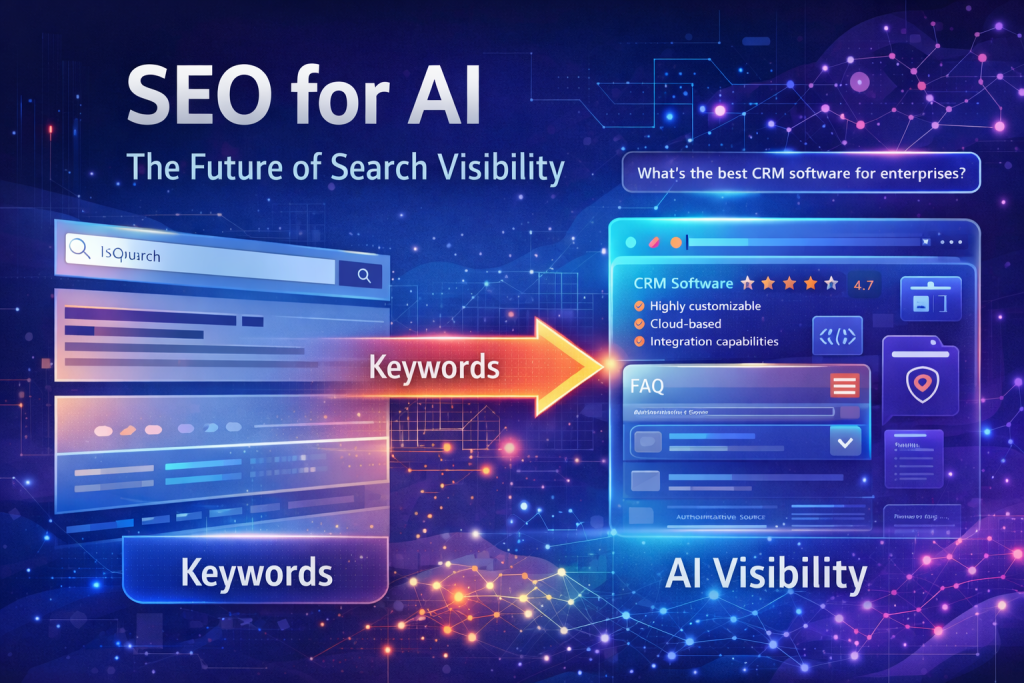
Search is evolving — fast.
For years, SEO meant optimizing for Google’s traditional search engine results pages. But in 2025 and heading into 2026, AI-powered search experiences — including conversational engines, generative summaries, and answer-based interfaces — are reshaping how information is discovered.
For B2B tech companies, this shift isn’t theoretical. It’s already happening.
If your SEO strategy is still built exclusively around rankings and keywords, you’re missing the bigger picture. Here’s why SEO for AI must become a core focus in 2026.
1. AI Search Is Reshaping Visibility
AI-driven search tools don’t just display links — they synthesize information into direct answers. That means your content may no longer compete only for blue links. It competes for inclusion in AI-generated summaries.
If your brand is not structured, authoritative, and contextually clear, AI systems may overlook it entirely.
SEO for AI means optimizing content so that:
It is easily parsed by machine learning models
It provides structured, authoritative answers
It signals expertise and relevance clearly
Visibility is shifting from rankings to inclusion in AI outputs.
2. Structured Data Is Becoming Non-Negotiable
Traditional SEO has long valued metadata and schema markup. In AI search environments, structured data becomes even more critical.
AI systems rely on clearly labeled information to understand:
What your content represents
Who it’s written for
What problem it solves
Why it’s credible
Without structured data, your content risks being misinterpreted or ignored entirely.
For B2B tech brands, schema implementation and semantic clarity will be foundational in 2026.
3. Authority and Original Insight Matter More Than Ever
AI engines prioritize trustworthy, authoritative sources. Generic content is less likely to be cited or surfaced in generative responses.
This means:
Original research
Data-backed insights
Industry-specific expertise
Clear thought leadership
…will carry more weight than surface-level commentary.
In other words, SEO for AI rewards depth over volume — aligning perfectly with the shift toward quality-driven content strategies.
4. Search Is Becoming Conversational
Users are increasingly asking full questions rather than typing short keywords. AI search responds in natural language, pulling from content that mirrors that style.
To compete, B2B tech companies must:
Address real questions directly
Write in clear, structured, conversational language
Include FAQs and intent-based sections
Optimize for long-tail, problem-oriented queries
The brands that answer complete questions — not just target keywords — will win.
5. Analytics Must Expand Beyond Rankings
Traditional SEO metrics like keyword position are becoming less predictive of true visibility.
In AI-driven environments, marketers must track:
Branded search growth
Referral traffic from AI platforms
Engagement depth
Content influence on pipeline
At CXGlobals, we view SEO through the lens of marketing analytics — not vanity metrics. The goal is not just to appear in search, but to influence buyer journeys and generate measurable business outcomes.
As AI search evolves, measurement must evolve with it.
The Bottom Line: SEO Isn’t Dying — It’s Evolving
SEO for AI is not a replacement for traditional optimization. It’s the next layer.
In 2026, B2B tech marketing leaders must think beyond keywords and rankings. They must optimize for:
Machine readability
Structured authority
Conversational intent
Trust signals
Measurable business impact
The companies that adapt now will not just rank — they will be referenced, summarized, and surfaced in the AI-driven search experiences shaping the future.
At CXGlobals, we help B2B tech firms build SEO strategies rooted in analytics, structured data, and forward-looking optimization — ensuring visibility in both traditional and AI-powered search environments.
Search is changing. The question is: will your strategy change with it?
For more information on our Web Development services and SEO-readiness, click here.